女生名叫黄蒲军校
India's 'Vision' is to Connect Iran's Chabahar Port to INSTC, Shipping Minister Sonowal Says_我的网站

A |
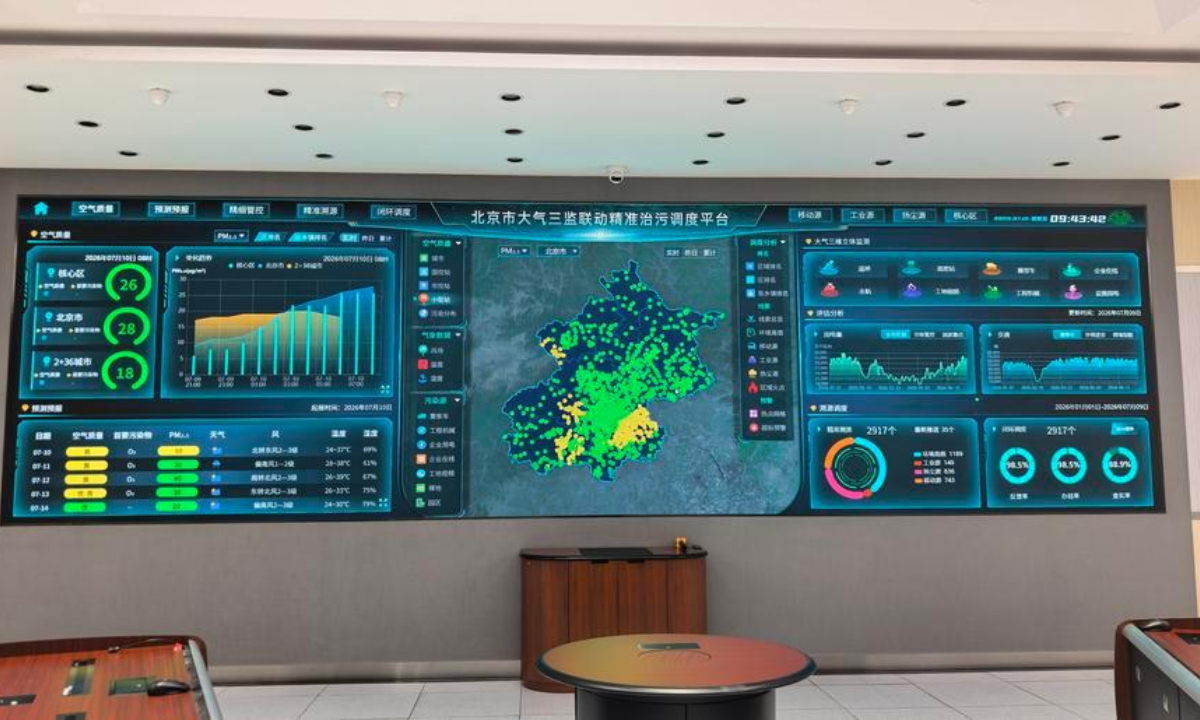
This photo taken on July 10, 2026 shows a data-driven environmental governance system, known as the innovative regulation-monitoring-inspection linkage model, showcased at the Beijing Municipal Ecological and Environmental Monitoring Center in Beijing, capital of China. (Xinhua/Sun Suying)Beijing's blue skies have become a visible sign of the city's progress in tackling air pollution, and behind that progress, digital technologies are playing an increasingly important role.
In 2025, Beijing recorded 311 days with good air quality and only one heavily polluted day, compared with 58 heavily polluted days in 2013, when the city officially began releasing PM2.5 monitoring data. The annual average PM2.5 concentration, a key indicator of air quality, fell from 89.5 micrograms per cubic meter in 2013 to 27 micrograms per cubic meter in 2025, a decline of nearly 70 percent.
The progress has drawn international attention. The United Nations Environment Programme has highlighted Beijing's experience in improving air quality as a model for other cities.
According to experts at the Beijing Municipal Ecological and Environmental Monitoring Center, the cleaner air is the result of a comprehensive system integrating environmental monitoring, scientific analysis, policymaking, regional cooperation and law enforcement -- with digital technologies now woven into every link of that chain.
MORE TARGETED APPROACH
Effective governance begins with accurate monitoring. Beijing has established a multi-level air-quality monitoring network. Figures show 35 standard monitoring stations across the city continuously measure six major pollutants, while more than 1,000 compact sensors deployed across communities and townships provide more detailed information on local air-quality variations.
The monitoring system was gradually built by the Beijing Municipal Ecological and Environmental Monitoring Center, one of China's earliest ecological and environmental monitoring institutions, responsible for monitoring Beijing's air, water, noise, soil environments and ecosystems.
The center has developed an analytical system that can identify around 125 components of PM2.5, covering most of its composition and helping researchers trace pollution sources.
"Source analysis helps us identify the major contributors to pollution at different stages, providing a scientific basis for policymakers to target key emission sources," said Li Yunting, technical director at the center.
Coordinated by the Beijing Municipal Ecology and Environment Bureau, the center has conducted four rounds of PM2.5 source analysis studies with other institutions, with results released in 2014, 2018, 2021 and 2025.
The latest analysis showed that regional transport contributed 57 percent of Beijing's PM2.5 pollution. Among local sources that accounted for the remaining 43 percent, vehicle emissions and residential sources represented the largest share of pollution, a distinctive characteristic of a major international metropolis.
The monitoring results have provided scientific support for a series of pollution-control measures. For example, Beijing has promoted new-energy vehicles to reduce transport emissions and adopted advanced techniques, including air-supported membrane structures, to control dust emissions. Meanwhile, coal combustion pollution, once a major contributor, has almost been eliminated and is no longer listed among the main sources, reflecting broader national efforts to reduce coal consumption, promote clean energy and upgrade heavily polluting industries.
With PM2.5 concentrations now at relatively low levels, further gains in air quality will depend on more targeted, science-driven approaches.
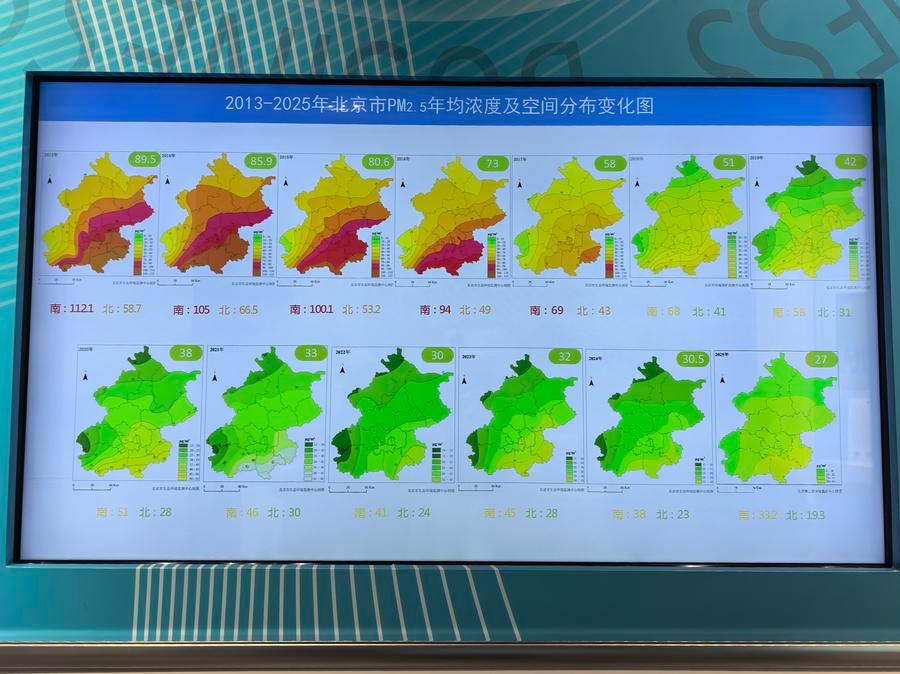
This photo taken on July 10, 2026 at the Beijing Municipal Ecological and Environmental Monitoring Center in Beijing, capital of China, shows the changes in the annual average concentration and spatial distribution of PM2.5 in Beijing from 2013 to 2025. (Xinhua/Sun Suying)
SMARTER ENVIRONMENTAL GOVERNANCE
Beyond monitoring pollution, Beijing has built a data-driven environmental governance system that links monitoring, regulation and enforcement in a closed loop from detection to action and follow-up evaluation.
Developed by the center and known as the innovative regulation-monitoring-inspection linkage model, the system integrates artificial intelligence, the Internet of Things, satellite remote sensing and vehicle-mounted monitoring technologies to pull together environmental data from multiple sources onto a unified platform.
"The system brings information that was once scattered across different departments onto a single platform," said Zhang Likun, director of the smart system division at the center, adding that this enables off-site enforcement and joint cross-sector actions involving housing, water resources and transportation, significantly improving the efficiency and precision of environmental management.
Using more than 30 intelligent algorithms, the platform automatically analyzes data and identifies potential pollution risks, based on which monitoring staff identify the most pressing problems and forward them to enforcement departments.
The approach has already drawn international attention. Clean Air Asia, an international nongovernmental organization focused on improving air quality across Asia, featured the system as a representative case study in its "China Air 2025" report. The model was also presented at the 2026 Better Air Quality Conference and recognized with the Certificate for Clean Air Best Practice Sharing.
China has integrated ecological conservation into its modernization drive. As the country speeds up efforts under the Beautiful China Initiative, Beijing's experience demonstrates how technology can support more precise, coordinated and sustainable environmental governance.
。 India’s “vision” is to connect Chabahar's Shahid Beheshti terminal in Iran to the International North-South Transport Corridor (INSTC) and reach Central Asian countries through the connectivity initiative, the South Asian nation’s ports, Shipping and Waterways Minister Sarbananda Sonowal said on Sunday.,“We urge all the representatives and stakeholders to come forward with suggestions to reduce the transportation time and cost further to make a cheaper, shorter, faster and more reliable route from India to Iran and Central Asia,” Sonwal said in his introductory remarks at the "Chabahar Day" conference in Mumbai.,The "Chabahar Day" event was attended by the ambassadors of Kazakhstan, Kyrgyzstan, Tajikistan, Turkmenistan, and Uzbekistan, as well as other high-level officials from these countries.,Sonowal's comments linking the fate of Chabahar to that of the INSTC came days after the first batch of cargo from Russia's Chekhov reached India's Mumbai port, as per media reports. The cargo first traveled on a train from Russia through Kazakhstan and Turkmenistan before it reached Iran, following the INSTC route. The cargo was then taken on a ship from Iran's Bandar Abbas port to Mumbai port.,India, on its part, has invested millions of dollars in the development of the Shahid Beheshti terminal at Chabahar, with Indian Prime Minister Narendra Modi earmarking $500 million for the port’s development during a visit to Tehran in 2016. The Indian government is also contemplating participation in developing the railway line between Chabahar and Zahedan, which is located at the Afghanistan border.,A port of opportunities. Speaking at the Chabahar Day program in Mumbai. https://t.co/KJj5XFu9zv— Sarbananda Sonowal (@sarbanandsonwal) July 31, 2022,Sonowal remarked at the conference that Chabahar could play a “vital role” in boosting trade in the region.,According to the Indian release, foreign dignitaries present at the conference agreed on the “potential” of Chabahar to “boost development” in the landlocked Central Asian region.,The remarks by the shipping minister on the significance of Chabahar came a couple of days after Indian Foreign Minister S. Jaishankar endorsed full membership for Iran in the Shanghai Cooperation Organization (SCO) at the upcoming Leader’s Summit in Samarkand on September 15-16.,“The SCO members will have the opportunity to use the facilities of the Chabahar port in Iran,” Jaishankar said while addressing the SCO’s Council of Foreign Ministers (CFM) meeting in Tashkent on Friday.,India has been backing operationalizing Chabahar port since the resumption of negotiations between the P5+1 (China France, Germany, Russia, the United Kingdom, and the United States) and Iran for the Joint Comprehensive Plan of Action (JCPOA), or the Iran nuclear deal, after President Joe Biden came to power in the US in 2020.,The previous Trump administration unilaterally pulled the US out of the JCPOA in 2018, creating uncertainty around the feasibility of Indian investments in Chabahar. While India’s operations in Chabahar were exempted from Donald Trump’s sanctions against Iran, Indian companies were held back by the fear of “secondary sanctions.”,During a visit to Turkmenistan in April, India’s then-President Ram Nath Kovind said New Delhi had taken steps to “operationalize” Chabahar port.。

B |
Current article:http://xvns.longdachemakuanshan.pics/list_jfym/j9nxx.html
Published on:01:36:31





 发表于 12:55:15
 QQ好友和群
 QQ空间
QQ空间 腾讯微博
腾讯微博 腾讯朋友
腾讯朋友 收藏
收藏 支持
支持 反对
反对
 发表于 09:08:37


