中国繁育最美蛇
23 humanoid robot teams compete in rescue missions at 2nd WHRG, facing real-world complexity beyond dancing in coordination_我的网站

A |

Guangxi faced its most severe flooding in decades, with 14 rivers at 20 hydrological stations surpassing warning levels by 0.37 to 7.69 meters. The Mingjiang River recorded its highest flood peak since records began in 1953, surging 6.69 meters above the warning level, while the Zuojiang River saw its highest levels since 1986, the Xinhua News Agency reported on Tuesday.
According to a report from China News Service, the flood which hit the Zuojiang River brought the peak water level to 123.54 meters, 7.34 meters above the warning level.
A total of 15,535 people in Longzhou county have been evacuated and relocated, while rescue teams are carrying out relief operations for affected residents, China News reported on Tuesday.
Longzhou county lies along the China-Vietnam border, where the Ping'er River, an upstream tributary of the Zuojiang River, flows across the border. Flood conditions in Longzhou therefore depend not only on local rainfall but also on water flowing in from Vietnam. The Chinese side remains in daily contact with the Vietnamese side to keep track of inflows along the Ping'er River, China News Service reported.
An earlier report from Xinhua said that, as of Sunday, the typhoon had affected 61,000 people across Guangxi, with 54,000 people relocated due to the disaster and 8,087 placed in emergency shelters.
Since forming on August 21, Typhoon Narra has barely moved, lingering over the Beibu Gulf. As of 1 pm Tuesday, its center was located over the Beibu Gulf about 55 kilometers west-northwest of Dongfang city in South China's Hainan Province, maintaining tropical storm intensity, China Central Television (CCTV) News reported on Tuesday.
The Guangxi water resources authority on Tuesday upgraded its flood-control emergency response for Guigang, while maintaining higher-level responses in several other cities, including Chongzuo, Fangchenggang and Nanning, CCTV reported.
China's National Meteorological Center (NMC) said Typhoon Narra would make landfall or brush past Hainan, making landfall in Guangdong and Guangxi coastal areas on Tuesday night or Wednesday morning. It was packing winds of up to 20 meters per second near its center, with gale-force winds extending 100 to 150 kilometers outward — roughly comparable to the distance between New York City and Philadelphia. Narra is expected to weaken rapidly after making landfall.
Global Times
。

B |
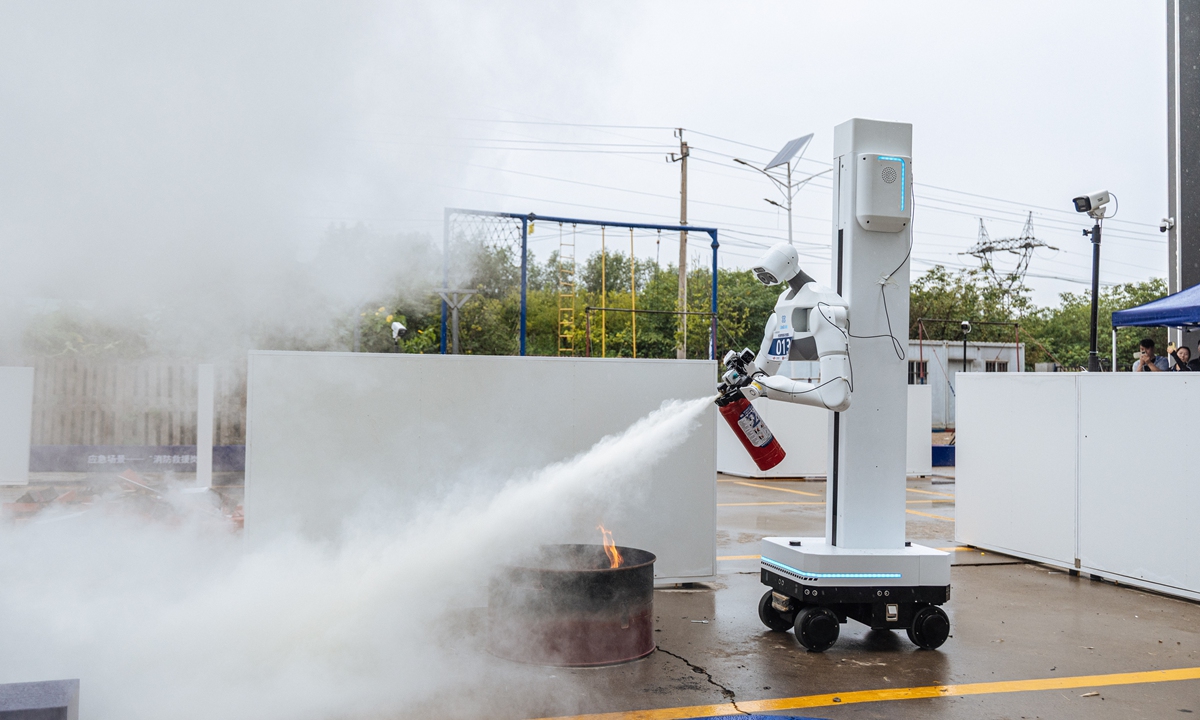
The firefighting final of the emergency management category at the 2nd World Humanoid Robot Games (WHRG) was held on Sunday in Beijing, putting 23 teams through a simulated rescue operation designed to test whether humanoid robots can move beyond demonstrations and perform practical tasks in complex real-world environments.
The event comes as Chinese humanoid robots, long known for eye-catching abilities such as running, dancing and music playing, are pushed toward practical applications, including jobs that are dangerous for humans such as emergency rescue.
Unlike the first edition of the WHRG last year, according to the organization committee, this year's scenario-based events emphasize "realistic simulation," with the firefighting competition being held at a fire brigade rather than in a model-room setup.
The competition simulated a firefighting assignment that required each of the 23 robots to complete three tasks within 30 minutes: identify hazardous materials, shut off valves and operate a fire extinguisher. For the first task, robots had to identify two randomly placed simulated hazardous substances and report their types to judges through returned images. They then had to locate three randomly selected open valves of different types and shut them off before identifying a fire source, finding a fire extinguisher and spraying it until the fire was put out.
Human firefighters were also involved in the event, lighting the fire and observing whether the robots carried out the extinguisher operation correctly.
The competition, however, showed how difficult it remains for robots to perform reliably outside controlled laboratory conditions.
Rain affected the competition, while changes in lighting and the outdoor environments added uncertainty to the robots' visual recognition and manipulation tasks. A team from UniX AI, a company well-known for its robot applications on real-world scenarios and has just raised a new round of 300 million yuan ($ 44.49 million) in late March, completed its run within the allotted time, but its robot moved relatively slowly compared to human firefighters' real practice. When operating the fire extinguisher, its robotic hand had to make two attempts to align with the target.
Of 12 teams competed on Sunday, three finished the challenge.
Yang Liqi, a representative of the UniX AI team, told the Global Times that the firefighting scenario placed higher demands on both the robot's recognition and manipulation capabilities.
"Rain and lighting conditions can affect the robot, and actual situations are often different from what we simulate in the laboratory," Yang said, noting that this was also one reason why a number of teams were unable to complete their runs on Sunday morning.
The team had programmed the robot to make up to three attempts when operating the extinguisher. "If it sees white smoke after the first attempt, it will not make a second attempt," Yang said.
The difficulty was not simply that whether the robot could move its arm. Humanoid robots rely on different types of joints for different tasks: small, high-precision joints enable delicate hand operations, while high-torque, reliable joints support movement and balance.
A failure at any point of actions and detection could affect the final result. This is precisely where the value of real-world competitions lies, Jin Chenran, a representative of the Tiangong team whose robot only accomplished one of the three tasks, told the Global Times.
"Whether the competition goes smoothly or not, that is the significance of a real-world simulation. Every real-world failure is valuable data that helps humanoid robots toward practical application," Jin said.
Jin further explained that questions like why the robot failed to recognize an object and how its motion-planning system selected the wrong path... Such data can subsequently be used to improve algorithms and train AI models.
The competition also offered a glimpse into the current transitional stage of humanoid robot technology. At the venue, some team members were wearing VR headsets and remotely adjusting their robots shortly before their runs.
Some humanoid robots were seen using omnidirectional wheels instead of feet, while their hands featured multiple joints to enable more precise manipulation. Many teams chose China-developed UBTECH's joint modules for their robots. Its servo actuators cover a wide torque range from 0.2Nm to 200Nm, allowing robots to combine dexterity with strength. Meanwhile, VR teleoperation gives operators a first-person view through the robot's cameras, enabling them to remotely guide movements in real time.
The event comes amid a broader push in China to move humanoid robots and embodied intelligence from laboratories and competition arenas into real production and daily-life environments. In June, the Ministry of Industry and Information Technology and the other departments launched a special program for humanoid robots and embodied intelligence that encouraged applications in practical fields including emergency rescue.
Zhao Weidong, deputy director of the organizing committee office, told the Global Times that the scenario-based competitions are intended to test the progress of humanoid robots from "competition performance" toward "real operational work," including whether they can eventually become intelligent partners for firefighters.
"At present, many simulations of actual operations may still be at an early stage," Zhao said. "But these are an important starting point for enabling robots to truly assist humans in real-world environments, as well as an important source of data and testing."
The ultimate goal, Zhao said, is to push robots into fields where human operations are dangerous and achieve genuine "human-robot complementarity."
。
Current article:http://xvns.longdachemakuanshan.pics/list_ldg/uki1b.html
Published on:08:53:48